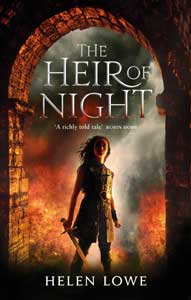

The A Geography of Haarth post series is traversing the full range of locales and places from The Wall of Night world of Haarth. Each locale is accompanied by a quote from either The Heir Of Night, The Gathering Of The Lost, or both.
This week we head further into “N” with Normarch, a locale of some prominence in The Gathering Of The Lost.
—
Normarch:Â the stronghold of the castellan of Emer’s Northern March
.
“Looking the other way, Carick could see the boughs of an orchard above the buttery roof, and wooded hills rising, blue in the distance. He had to lean right out the window to catch a glimpse of the castle, which was built of the same gray stone as the inn. Its walls were considerably lower than those of either Ar or Terebanth, and the central stronghold was little more than a single donjon with a series of roofs stretching away on either side. Halls, Carick supposed, cudgeling his memory for details of Emerian castle architecture, and there would be armories and more stables as well. Kitchens, too, he thought, as fresh baking aromas drifted up to the window. He felt hungry again already.
Craning further out again, Carick saw figures wheeling and maneuvering on horseback beneath the castle walls. He spotted archery butts as well, and guessed that these must be the garrison’s training fields. A working stronghold, he thought, and remembered what had been written in a cramped hand on one of the few maps of Emer to be found in Ar. Normarch, the notation had said, and then, in even smaller letters: the Duke’s bridgehead in the north.”
~ from © The Gathering Of The Lost, The Wall of Night Book Two: Chapter 13 â Normarch
Today is Waitangi Day, New Zealandâs national holiday, when we commemorate signing of the Treaty of Waitangi between the Maori Chiefs of New Zealand and the British Crown.
Throughout my adult life, Waitangi Day has become the focus of protest about the wrongs from the many instances, throughout the past 174 years, in which the Treaty has not been honoured, to the detriment of the Maori people. As I acknowledged in my 2012 post, Waitangi Day: âHe Iwi Kotahi Tatouâ, these are very real issues and need to be addressed — but I also feel that we “…as a country…have a great deal to celebrate that is about being here together.”
I talk about some of those things in that post, including our literature. As a person who did a significant part of my growing up in a predominantly Maori community in the North Island’s King Country, I can’t shake the conviction that February 6 can still be about aroha (loving goodwill) and celebrating us.
I mentioned literature and I am a writer, so here are a few of the books that have celebrated us, for me:
The Year Of The Shining Cuckoo by Joyce West
Predominantly about a boy and a horse, this children’s book is set in a rural area where the community comprises both Maori and Pakeha New Zealand. First published in 1961, West was aware that she was depicting a world that was already fast vanishing — but I continue to recognise the small community of my own childhood in elements of the story.
Mutuwhenua, The Moon Sleeps by Patricia Grace
Patricia Grace is one of New Zealand’s foremost novelists and in 2012 I mentioned her novel Tu, which won the Deutz Medal for Fiction or Poetry at the (then) Montana New Zealand Book Awards 2005. (An earlier novel, Potiki, had also won the fiction section of the New Zealand Book Awards in 1987.) I think, though, that Mutuwhenua will always be my personal favourite, not just because it’s the first book by Grace that I read, but also because it was one of the first adult NZ novels I read that really spoke to my personal experience of New Zealand.
Whanau is another novel that I identify as being amongst the first to really speak to my experience of New Zealand. I was studying in Sweden at the time, a very long way from home, and I will always remember reading the opening description of the community and approaching it through getting on the local bus — and thinking: “Yes, yes: this is how it is.” That feeling of recognition and “yes” stayed with me throughout the novel, which is possibly why, although I know there has been a new updated version published subsequently, I will never replace the version I first read.
So far, I have focused on novels that ‘speak to us’ in terms of the overlap between Maori and Pakeha (NZ-ers of European origin) cultures. But if Waitangi Day and the Treaty are about nationhood, then ‘celebrating us’ also encompasses stories from within one culture, or which transcend it. (I would argue that Whanau comes close to being told from within one culture, too.) Books that have done that for me include:
The shock of recognition and delight in his book was the account of a small town, Pakeha New Zealand childhood that bridged the generation between my own experience and the stories my mother told me. It is not quite my own experience, but I recognise a great deal of what it contains nonetheless — and hear the echo of my mother’s story in that of the mother in the book.
Three cultures overlap in this book: Maori, Pakeha and Chinese — but what I admired most about the story is the way it transcends cultural divides to create something that is distinctively and authentically Kiwi. I also really like that although I have heard the story described as ‘magic realism’ I couldn’t really tell you what kind of tale it is — just that I loved reading it.
Anyway, this is just a handful of the books that I could have mentioned — but I thought I’d better save a few for next year. đ
Tena koutou katoa: enjoy your Waitangi Day everyone.
On Monday, I linked through to my February 1 feature post on the Supernatural Underground, Streetwise Heroines.
In the post, I talked about a few criteria that I feel determine a streetwise heroine, including that she:
- is either from the wrong side of the tracks or able to operate on that turf
- fulfills the 3 “S’s”: strong, savvy, and sassy
- is a little bit badass, as well — but with a heart that’s in the right place; and
- a fourth “S” — sexy — was rated as ‘desirable (possibly) but not essential’
So how does Malian, the heroine of my own Wall of Night series, rate against these criteria?
She’s not from the wrong side of the tracks — far from it: as Heir to the warrior House of Night, Malian is definitely an aristocrat. I feel though, that events in The Gathering Of The Lost (GATHERING) make it pretty clear that she is capable of operating on the wrong side of the tracks.
Malian is also strong and savvy, and although “sassy” may not be quite the right word for an epic fantasy world, she’s definitely assertive and has plenty of what was once called “sand” (i.e. nerve; courage)
In terms of “sexy” — well, she is a little young for that adjective in The Heir Of Night (HEIR) — and I will leave those who have read GATHERING to make up their own minds on that point.
A little bit badass — again, not so much in HEIR, but the element does creep in for GATHERING.
Is her heart in the right place: again, readers will have to make up their own minds, especially in GATHERING, but my feeling is that so far she is more on the side of the angels than not…
So overall, I do feel that Malian of Night has enough of the baseline attributes to qualify as a “streetwise heroine” — dissenting opinions, with reasons (but no spoilers!), welcome however. đ
Welcome swallows
swoop and dart — here
then not here
© Helen Lowe
—
Toward the end of last year I spent upward of 5 weeks in a remote coastal location, working on my current book.
I also wrote a number of haiku during that time, which I shall be featuring here over the next few weeks. As these are works in progress, your feedback/critique is welcome.
—
To read the featured poem on the Tuesday Poem Hub and other great poems from fellow Tuesday poets from around the world, click here or on the Quill icon in the sidebar.
February 1 has rolled around so that means I have a new post featured on the Supernatural Underground.
This month I’m talking “Streetwise Heroines”:
“I don’t think we could have paranormal urban fantasy without the streetwise heroine â but of course that begs the question as to what makes a heroine ‘streetwise’?”
To find out my conclusions as well as a few favourite streetwise gals, check out the post:
Streetwise Heroines
Do tell me if I’ve missed any essential ingredients for street wisdom — and add your own personal favourites to the reading list. đ
“A reflective observant prince with a knack for reading. I like Prince Sigismund of Thornspell by Helen Lowe already.”
—
Nancy Cudis is a reader in the Philippines and her comment came through via Twitter.
We don’t commonly hear our own accents, but I’m told New Zealanders — or “Kiwis” as we often refer to ourselves — are popularly held to have reduced the English language’s vowel 5 sounds to approximately 2.5.
Be that as it may, I thought you might like to learn how to “pronunciate New Zild” all correct-like… đ
Starting at the very best place, i.e. the beginning, with “A”:
“A is for Uh” — a sound commonly used when pausing in mid-speech…
This, of course, would mean that “Asantir”, in the Wall Of Night series, is pronounced “Uhz-un-tir.”
So now you know! đ
The A Geography of Haarth post series is traversing the full range of locales and places from The Wall of Night world of Haarth. Each locale is accompanied by a quote from either The Heir Of Night, The Gathering Of The Lost, or both.
The series has now passed the alphabetical halfway point, as it’s onwards into “N.”
—
New Keep:Â the ‘newer’, inhabited stronghold of the House of Night’s bastion, the Keep of Winds
.
“Malian laughed aloud, but sobered as they turned into the golden blaze of the New Keep. Darkness never fell in these corridors and halls where jewel-bright tapestries graced the walls and the floors were patterned with coloured tiles. Pages sped by on their innumerable errands while soldiers marched with measured tread and the vaulted ceilings echoed with all the commotion of a busy keep.”
~ from © The Heir Of Night, The Wall of Night Book One: Chapter 1 â The Keep Of Winds
.
“Garan, looking past her, saw the two young priests toward the rear of the company. They still wore the silver-gray robes of initiates, although with the black trim and winged-horse emblem that denoted those who kept the now five-year-old watch on the portals between the New Keep of Winds and the Old. Vern was studying the Stone priests, his expression serious, but Var smiled slightly when he caught Garanâs eye.”
~ from © The Gathering Of The Lost, The Wall of Night Book Two: Chapter 28 â Border Crossing