
Karen McMillan is a friend and fellow New Zealand author—and she also does reviews, generally across a range of literature genres (although not usually SFF/speculative fiction.)
If you’re interested in reviews, particularly in the contemporary realism, crime-thriller, chicklit and non fiction areas, you should definitely check out Karen’s review page, here.
One of the books recently reviewed by Karen is Kate Mosse’s novel Citadel, the third in her timeslip (which is, after all, a form of speculative fiction) series that began with the international bestseller Labyrinth, and continued with Sepulchre. Today, with Karen’s permission, I am publishing her full review for Citadel here.
—
Review: “Citadel” (Orion Publishing, 2012, 704 pp) by Kate Mosse
Release date: 30 October
Review by Karen McMillan
This is an impressive ‘time-slip’ novel that encompasses two story lines that come to an explosive intersection near the end of the book. Both stories are set in the far south of France in Carcassonne, evoking the eerie beauty of the region. One story concerns a monk and an ancient script, a Codex, that has the ability to summon up a ghost army back in AD 340. The main story is set in the World War II. Sandrine is a young naive woman, living with her older sister Marianne, until a demonstration in their local village goes wrong and innocent people are injured. At the demonstration, she meets Raoul, a young man who mysteriously saved her life by the river but then disappeared. The connection between them is instant and it doesn’t take long for them to begin a torrid love affair, even though he is a wanted man by the Gestapo. Sandrine learns the truth of what is happening under her nose and joins her sister and her friends in a female-only Resistance group, taking increasingly dangerous jobs in their fight for freedom. But then she meets the elusive Monsieur Baillard, who is looking for the Codex that is centuries old that he believes will help them in their time of need, and Sandrine becomes the crucial person in summoning this ancient power.
This is a remarkable novel. It has intrigue, danger and true emotional clout. The ending will leave you winded, but you will want to read on to the very last page. A bittersweet, beautifully written novel, original, thought-provoking and completely engaging.
For more information on Kate Mosse’s writing, see her site here
—
About the Reviewer:
Karen McMillan lives in New Zealand and is the author of both fiction and non-fiction. She has a Diploma in Professional Writing and an Advanced Diploma of Applied Arts (Writing). Her non fiction title, Love in Aotearoa, was short-listed for the Ashton Wylie Book Award in 2005.
Previously an award-winning fashion designer, Karen has worked full-time for a leading book publisher based in New Zealand for the past twelve years. Karen has written articles for a variety of different publications and from time to time she takes on ghost-writing projects. She also volunteers for her local hospice and writes articles that promote the life-affirming work that they do.
As “…on Anything, Really” followers probably know, I am currently doing a “Fun With Friends” series for SF Signal, interviewing one fellow New Zealand or Australian SFF author per month.
(I would love to do more, but time, ‘little grasshoppers’, time… And I, alas, unlike the redoubtable Miss Hermione Granger, have no time-turner…)
But one thing I feel is really important if one is going to interview a writer, is to read their work. Because by and large, that is where the interest in interviewing an author comes in, right? (Right! ;-))
So although it will be some time before I interview Karen Healey for SF Signal I am absolutely delighted to have received an advance reading copy of her forthcoming novel, “When We Wake.”
Most importantly, I shall have plenty of time to read, savour and enjoy. And I have to say that I am looking forward to it, based on my read of Karen’s debut novel, Guardian of the Dead, which I talked about here.
—
Meanwhile, here’s what the back cover says:
“My name is Tegan Oglietti, and on the last day of my first lifetime, I was so, so happy.
Sixteen-year-old Tegan is just like every other girl living in 2027–she’s happiest when playing the guitar, she’s falling in love for the first time, and she’s joining her friends to protest the wrongs of the world: environmental collapse, social discrimination, and political injustice.
But on what should have been the best day of Tegan’s life, she dies–and wakes up a hundred years in the future, locked in a government facility with no idea what happened.
Tegan is the first government guinea pig to be cryonically frozen and successfully revived, which makes her an instant celebrity–even though all she wants to do is try to rebuild some semblance of a normal life. But the future isn’t all she hoped it would be, and when appalling secrets come to light, Tegan must make a choice: Does she keep her head down and survive, or fight for a better future?
Award-winning author Karen Healey has created a haunting, cautionary tale of an inspiring protagonist living in a not-so-distant future that could easily be our own.”
On Monday, I posted my initial reflections on the importance of character, essentially arising from last week’s guest blog posts with SF Signal–the Mind Meld on Heroes, here—and Abhinav Jain in his guest author series on the importance of names in Fantasy, here. These posts led me to reflect on some of the characters in The Wall of Night series and the testing of “who they are” and “what they are about” through the action in the story.
Writing characters is challenging and exciting and fun—but it’s even more of a blast when readers start writing and telling you what “speaks to them” about characters in your stories.
In Monday’s post, I talked a little but about the Earl of Night in the context of reader feedback. But he is not alone in that respect. A reader in Australia wrote to tell me that: “The thing I really like about … [the character of] … Kalan is that he has not lost his spirit even though he has become a person his whole family despises. He still has hope and kindness in his heart.”
Yes, I thought, yes: that’s exactly right.
Another reader also liked the heralds of the Guild, Jehane Mor and Tarathan of Ar, who have powers “…and are not afraid to use them.” This particular reader found the heralds “… perhaps the other two most interesting characters of the whole book (the other two being Malian and Kalan.)”
Different readers, different perspectives—but as a writer I am rewarded to find readers being drawn to a range of the characters that appear within the series, especially since there are two principal characters (Malian, the Heir to the House of Night, and Kalan) and several others that count as “major.”
One of these “majors” is the Honor Captain, Asantir, and in my post on “The Power of Names” I discussed how her arrival in the story was relatively unexpected for me as the author and arose from a change in name. To find out the how and why, you will have to read the article, here — but what I learned from this process (but should have known given the number of Fantasy stories based around the concept!) is that names are powerful and changing them can be a dangerous business.
Needless to say, whenever I think about changing anything about a character now, from name to hair color, I always do so with extreme care. Because characters, it seems, just like real people, have minds of their own—but perhaps that’s because, if I’m doing my job right, within the pages of the book they are real people: they have to be, in fact, in order to live for you on the page.
Today is Canterbury Poets’ Spring Reading Series No.3, with three excellent guest poets appearing, including my friend and very successful poet, Frankie McMillan, together with Joan Fleming and Andrew Coyle, the latter of whom I know from the Catalyst Open Mic poetry nights.
Tonight’s event will run from 6.30 pm at the CPSA hall, Christchurch Polytechnic on Madras Street, commencing with a BYO Open Mic.
(The programme for the full eight weeks is here.)
—
In the past, I have featured the following poems by Frankie McMillan. Click on the links to find out more:
Tuesday Poem: “Out of the Blue”
Tuesday Poem: “My Father, the Oceanographer”
Joan Fleming was featured on the Tuesday Poem Hub in 2010, with her prose poem “Auntie talking to her niece.”
Today I am the guest editor for the Tuesday Poem Hub where I have featured Listening to Glenn Gould on Orton Scar, by fellow Tuesday Poet, Kathleen Jones, from her collection “Not Saying Goodbye At Gate 21” (Templar Poetry, 2011.)
So I would love it if you clicked through to The Tuesday Poem blog and read the poem—and perhaps, if you really felt moved by the spirit, you could even leave a comment. ![]()
Click to read Listening to Glenn Gould on Orton Scar, by Kathleen Jones, Here
I featured another poem by Kathleen, Winter Light, here on the blog on December 20, 2011: it is also a wonderful poem and you can read it right here.
You can also read fellow Tuesady poet, Tim Jones’s feature of another Kathleen Jones poem, To the Gods, the Shades (a personal favourite!) here.
—
Also, by clicking through to the Hub you get to read all the really great poems by other poets in our international Tuesday community, all featured in the blog’s side bar.
Last week, I was pleased to be able to guest post on two blogs. I participated in the latest SF Signal Mind Meld, “Holding Out for a Hero”—on heroes in SFF—which comprised a diverse range of views, all well worth a read, here.
I also contributed a post to blogger and reviewer Abhinav Jain’s “Names: A New Perspective” guest author series, with an article on “The Power of Names” in my writing, here.
Preparing both posts got me thinking about how ideas, whether around heroism and villainy, or the use or abuse of power, get to “work their way out” through a story.
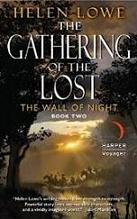
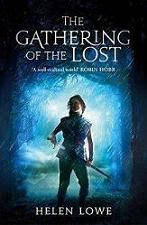
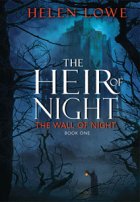
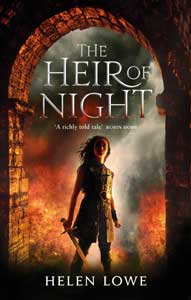
In The Wall of Night quartet (with Book One, The Heir of Night and Book Two, The Gathering of the Lost currently published) the story is definitely all about the characters: who they are, what code of values they subscribe to—and how they behave in relation to those values when the chips are down. (You may be starting to see the link to my contribution to the Heroes Mind Meld now.:) )
In part, that may be why both The Heir of Night (Heir) and The Gathering of the Lost (Gathering) are adventurous stories as well as being character driven: because it’s only when the going gets tough that the person you believe you are gets tested. (Although, it’s also because I like treks into dangerous territory, sword fights, hunts and battles with demons in my storytelling, to be strictly honest!)

USA
In Heir (the first book in the series), the two central characters of Malian, the Heir of Night herself, and Kalan, are both young (not unlike the five Stark children in George RR Martin’s A Game of Thrones), but dark events are thrust upon them. How they deal with that is very much part of the story, so that Malian at the beginning of Part 2 of the story, despite her youth, already has a harder edge than the girl in the opening scenes of the book. By the end of Heir, she is presented with a request—and how she responds, based on the values she adheres to—or doesn’t— will cast its shadow over the play of events in Books 2 to 4 of the quartet.
But perhaps one of the more complex characters in Heir, particularly in terms of values and being tested, is Malian’s father, the Earl of Night. As one reader said to me: “Oh you can just feel the weight resting on him.” I have to say, this pleased me, because it is very much how I hoped that the Earl would come across: not as a straightforward personality, but as a man caught between opposing forces and conflicting values—between his personal inclination and difficult circumstances. The responsibility of leading not just his own house of Night, but the Derai Alliance itself, through those circumstances does rest very much on him as the story opens—which means that his personal inclinations are tested, sometimes even severely tested. Needless to say, he is not necessarily an easily likeable man—but I hope that readers will find him an interesting one!
An epic story, testing times, and characters under pressure—or a tale of adventure, battles and hunts? I love stories that weave the two elements together, so it’s probably not surprising that The Wall of Night series works at both levels.
In my recent Monday updates, I’ve mentioned that the Canterbury Poets’ Collective Spring Season of poetry readings is currently in full swing. One of the guest poets on the first evening was Johanna Aitchison and I am currently reading her collection “A Long Girl Ago” (Victoria University Press, 2007.)
And I have to say that I am enjoying it very much, as I did Johanna’s reading on October 3. She has a distinctive “voice” and also uses alter egos, such as “miss red” in this collection, as a way of experimenting with and extending the narrator’s voice within the poems.
Here’s a few lines to give you the flavour:
‘steel to fm daylight picks
down williams road paihia
middle of summer bro’
— from ‘the smell calls out hot’
and:
” The sun hits the tips of waves in Lyall Bay, the big wing, your
sunglasses as you fly into Wellington again. The blow of water,
the salt, salt water, would taste like lips after fish and chips.”
— from ‘is anybody in there’
also:
” I make telephone calls
to my bones, eat evenings
full of 12-year-old
video credits.”
— from “miss red in japan”
—
For an indepth review of A Long Girl Ago, you may read Joan Fleming’s review, published in “The Lumiere Reader”, here.
For the full list of the forthcoming spring season lineup of readings, see my post here. (And interestingly, one of next week’s guest poets is Joan Fleming.)
The paranormal & supernatural is very much the home turf of the Supernatural Underground—and that makes Halloween a festival of note for those who post on the site.
To really make Halloween rock this year, Supernatural Underground authors are doing a paranormal giveaway extravaganza—and not only will there be related posts on the blog, but some authors will also be doing extra features on their own sites.
So if you like Halloween, the paranormal and supernatural in your reading, as well as “ghouls, ghosties … long-leggedy beasties, and [all] things—[including books!]—that go bump in the night” you may like to head on over to the Supernatural Underground and —
— check out what it’s all about, RIGHT HERE. 😉
Recently, I was delighted to receive an invitation from book blogger and reviewer Abhinav Jain to participate in a guest author series on “Names: A New Perspective.”
To elaborate: “The topic is how the names of characters and places and other things within their novels (and other works where appropriate) fit into their setting, their relevance and their power.”
.
My post, titled “The Power of Names”, is featured now and you can check it out Here.
One of the exciting things about the series from my point-of-view is that it comprises new or debut Fantasy authors, so it is a chance to find out more about some of the new kids on the SFF block and get a feel for what their stories are about.
As host, Abhinav is also posting his reviews of each guest author’s books, as well as his thoughts on each of our perspectives on “names”, which I feel adds further interest to the series.
And as always, comments on the post and/or topic are always very welcome. 😉
—
To date, the series comprises the following posts (click on the title to read):
- Myke Cole (Control Point — military SFF): “The Significance of Names”
- Chris Holm (Dead Harvest & The Wrong Goodbye — urban fantasy/crime): “The Devil’s in the Details”
- Kim Curran (Shift — Young Adult SFF): “Names Are Fun”
- Teresa Frohock ( Miserere: An Autumn Tale — Fantasy): “A Game of Names”