
Handwritten, from the heart
There is only Us,
our collective heart torn apart,
one hundred members of our community
dead or grievously injured
at Al Noor and Linwood mosques.
We all came here, at our different times,
in hopes of making fresh starts,
new beginnings, peace.
We have too often failed in Waitangi’s promise
of “He iwi kotahi tatou —
Now we are one people.”
Together, we must keep on trying.
Nothing can replace the fifty lives lost,
but together we can hope for healing
of the fifty injured. Together,
we can hope to make that fresh start,
to build a stronger future for all of us,
to sow love where hate has carved its wound,
to restore peace or to make it new.
— Helen Lowe

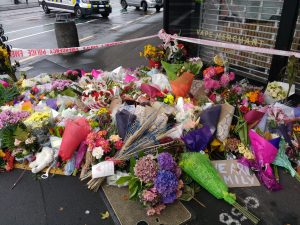
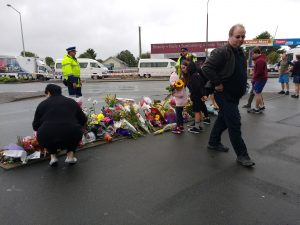
Floral tributes near Linwood mosque
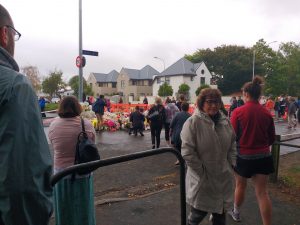
I wrote this last Sunday, before my partner and I took flowers to the Al Noor and Linwood cordons. Later, I wrote a more formal post, trying to formulate some sort of response to the terror attack, a response I felt was necessary because the murder of fifty fellow human beings, the majority of them fellow citizens, and the wounding of fifty more, took place not just in my country, but in my home city. That post can be read here:
A Dark Day
These words, though, were the first ones I wrote, the words of my heart.

Among 20,000: all here to show support
Last Friday, exactly one week on from the two acts of terror, I went to Hagley Park, along with ca. 20,000 others, to support the Christchurch Muslim community in their first public religious service since the attacks. In that service, Imam Gamal Fouda of the Al Noor mosque, and a survivor of the attack, captured the mood of the afternoon, speaking eloquently & movingly of compassion & peace, mercy & togetherness. His full speech is here:
Imam Gamal Fouda
In the past ten days I have heard the harrowing accounts of survivors and family members. There have also been so many inspiring and moving moments in answer to the attacks and horrific loss of life that it’s impossible to list them all. Nonetheless, they have meant a great deal in the face of such dark and bloody acts. Prime Minister Jacinda Ardern, leading by example, has inspired us all.

Leaving Hagley Park, after the service
Today, I would like to say only one thing more. On Friday, some New Zealand women who attended the support events chose to wear a hijab to show visible support for NZ’s Muslim women. I saw a great deal of discussion of this on the internet. (Of course I did!) One common statement, when NZ was criticised for this particular aspect of our response, was (here I summarise and paraphrase) that “they” (Muslim communities in the commenter’s country or around they world) wouldn’t “do the same” (i.e. remove their hijabs, wear a cross or a Star of David or other religious symbol) if a similar atrocity “was committed against us.”
My response on first seeing these comments, and now, remains the same: Actually, it doesn’t matter what “they” (whether Muslims or other religious or cultural groups in like circumstances) might or might not do at some time in the future. All that matters is what we choose to do now, in response to this act, out of the love in our hearts — and certainly not in the spirit of a transaction that hopes for a future return.
Having said that, I believe that Imam Gamal Fouda’s words on Friday also epitomise love and a generosity of spirit that at least matches the aroha and support from his fellow New Zealanders.
Today I wish you love, compassion, kindness, generosity of spirit and peace. May we all be willing to show it, regardless of whether we find it in return.

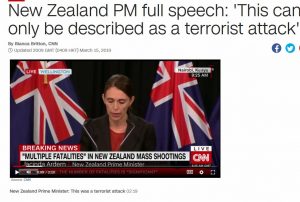 and her statement can be viewed here:
 The
The 

 On 1 March I started a


 Last month,
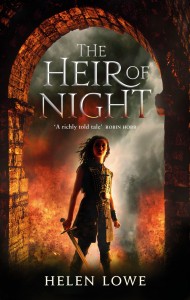

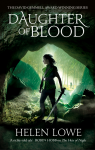
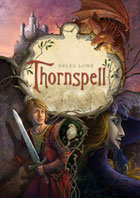 In terms of my published work, I believe the historical influence is most evident in Thornspell, which evolved as a Middle European-style kingdom very much in the style of the Holy Roman Empire and its affiliated states in the early Renaissance period. The period is recognized in terms of clothes, technology (which includes armour, weapons etc) and the broadbrush of how the nobility live.

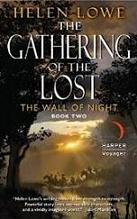


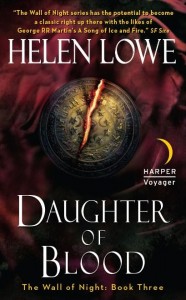
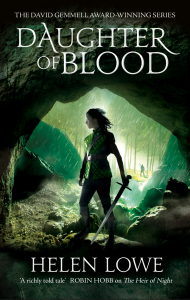
 Recently on Good Reads (GR) I was asked a question about worldbuilding. I’m not terribly active on GR because there’s only so much social media a gal can do in a meaningful way and still write books and deal with realtime life, so questions are a relatively rare event. 😉
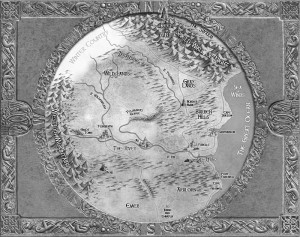
 As I grew up and my original world idea developed, I realized that a dark world, while atmospheric, made for challenging worldbuilding and difficult storytelling, so I revised the “darkness” back to more of a twilit world, with an accompanying stark and bleak landscape, that became the Wall of Night. I also originally thought the wall would be an actual constructed wall (like the Nightwatch’s Wall of Ice in A Game of Thrones) but the more I thought about it the more the “mountain range as shield-wall” idea took hold.
 Other “Big Ideas” I (believe I) perceive in Fantasy worldbuilding, which pervade the stories, include:
 If you think of a world as being similar to a human body, the spine is the central column, or core idea, that connects everything else.
 In order for the world to be real for readers, it must first be real in your mind so that the characters can experience their surroundings in a real way.
 Yet it is not enough to simply experience, the characters must also respond emotionally to what they experience. For example, in any given situation, does the character feel fear or horror, foreboding or doubt; happiness or confidence? Do they respond to stimuli with joy and delight, or disgust and loathing?
 The reality of the worldbuilding will help you, as author, to know how your characters respond. It will also help your readers not only understand what’s going on for your characters, but to understand environment and world through their senses and perceptions, i.e. the world becomes real for all involved.