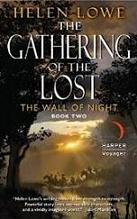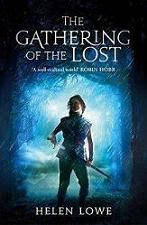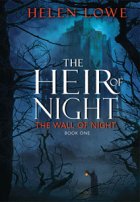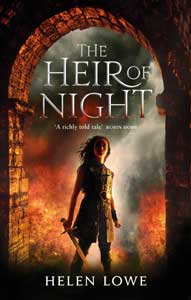

The A Geography of Haarth post series is traversing the full range of locales and places from The Wall of Night world of Haarth. Each locale is accompanied by a quote from either The Heir Of Night, The Gathering Of The Lost, or both.
This post continues our exploration of places beginning with “S.”
—
Secret Isle: an island of Ij, home of the School of Assassins
“Jehane Mor stared up at the timeworn plinth, noting the goddess’s compassionate gaze and the lion’s watchful stare before she bowed her head. The god Seruth, she knew, would stand on the other side of the bridge. In Ij, it was always Imulun who looked toward the city, while Seruth, guardian of journeys, faced the outside world—everywhere, that is, except for the bridges that led to the Assassins’ School. The god Kan, the Dancer in Shadow, always kept watch over both those who entered and those who left the Secret Isle.”
~ from © The Gathering Of The Lost, The Wall of Night Book Two: Chapter 3 — Revelry and Masks

Amongst other things, I’m re-reading m’own books… Which can feel decidedly weird at times, given I know exactly what is going to happen—but it’s all for a worthy cause, making sure that plot threads sown in the earlier books are being picked up as required in WALL3, or being set up for WALL4. Not to mention a general continuity check back through the earlier books.
It’s still weird though, even if continuity-wise it’s a case of “so far, so good.”
My natural instinct is not to re-read, I must admit, but although I hope beta readers will pick up on continuity matters I can’t help but feel that the primary responsibility lies with me as the author.
So I shall “read on.”
I am in The Gathering Of The Lost now and looking forward to the flow-through into the Daughter Of Blood manuscript — with all digits crossed that the transition will prove to be a smooth one.
by Rebecca Fisher
Introduction:
I’m taking advantage of this month’s alliterative opportunity and calling this next segment of Big Worlds on Small Screens… Miyazaki May. That has a nice ring to it. You may have heard of Japanese filmmaker Hayao Miyazaki, but you probably don’t know the full extent of his influence on the animation industry. This is a man who has been called the Walt Disney of Japan, whose 2001 film Spirited Away won the Academy Award for Best Animated Feature, and who is credited as a major inspiration by the animators at Pixar.
If you have never seen any of his films, then you are most definitely missing out.
The man of the month: Hayao Miyazaki
So what is it about Hayao Miyazaki’s work that’s so special? The best I can do is recount my own first experience with one of his films. It was Spirited Away. I had heard the Oscar buzz about it and so decided to check it out without any prior knowledge of what it was about. I rented the DVD and for the next one hundred and twenty minutes, was utterly captivated. Sometimes confused, sometimes caught off-guard at the direction the storyline went, sometimes a little creeped out by the strange imagery, I was nevertheless completely riveted by the film that was unfolding before me.
So your first Miyazaki film might seem a little strange, but as you begin to explore his work, several consistent themes emerge. In a typical Miyazaki film, you won’t find any black-and-white morality; rather everything is depicted in varying shades of grey, and even the most frightening villains will be given a multi-faceted personality (or at least justification for their crimes). You’ll also find plenty of female protagonists who embody the values of bravery, compassion and open-mindedness, as well as exploration of environmental issues and anti-war rhetoric. Such things can be the death-knell for other stories, but in a Miyazaki film they’re dealt with subtly and so carefully woven into the fabric of the story that it never feels as though you’re being preached to.
From very safe and child-friendly fare (such as Kiki’s Delivery Service and My Neighbour Totoro) to dark and violent epics (like Princess Mononoke and Nausicaa of the Valley of the Wind), every film boasts animation that beautifully captures fantastical animals, foreign landscapes and the exhilaration of flying. But perhaps the most wonderful thing about Hayao Miyazaki’s films is their ability to create wonder out of ordinary things. Here a bike ride down a steep hill or getting caught out in the rain is depicted as just as incredible and fascinating as a chance meeting with a spirit or being catapulted into another world.
Premise:
We’ll start with one of Miyazaki’s first films, one which exemplifies many of the traits I’ve already mentioned: Nausicaa of the Valley of the Wind.
Free-spirited Nausicaa on her glider
It’s set in a post-apocalyptic world thousands of years into the future, after an event alluded to as the Seven Days of Fire left civilization as we know it destroyed and humanity’s remaining population scattered into isolated communities. Most of the globe is overrun by toxic jungles that produce spores deadly to human beings, and explorers must use gas-masks to protect themselves whenever they venture out into the wilderness.
Added danger comes from the insect life that now dominates the earth, particularly those known as the Ohmu. They look rather like giant pill-bugs with bulbous eyes that change colour depending on their moods, and it is their dead bodies that produce the poisonous spores that make life so difficult for what remains of humanity.
The peaceful Valley of the Wind
In this dangerous new world there are a few pockets of civilization left; cities such as Torumekia and Pejite, who are constantly at war with each other, and the Valley of the Wind, favourably located to take advantage of the wind from the sea. Not only does it keep the poisonous spores from settling, but it powers the windmills that supply water and energy to the farming community.
Story:
The film begins when Lord Yupa, a master swordsman, runs into the eponymous Princess Nausicaa on his way back to the Valley. Yupa claims that he’s trying to unravel the mysteries of the eco-system, though there are rumours that he’s searching for the subject of a prophecy: “a person clad in blue standing in a golden field who will find the bond between humanity and the earth, and lead the people to a pure land.”
All seems peaceful, but that night an airship crash-lands in the Valley, struggling against a swarm of infuriated insects. Nausicaa uses her glider to try and help, only to find a young girl in handcuffs thrown clear of the destroyed ship. With her dying breath she gives Nausicaa a message: “burn the cargo.”
Nausicaa tries to subdue a furious Ohmu
The war-like Torumekians arrive to reclaim their ship, garrisoning the Valley while they’re at it. Nausicaa soon learns that their mysterious cargo is a weapon that they claim can obliterate the toxic jungle and take back the world for humanity – though the neighbouring Pejites are horrified at the thought of such a dangerous weapon in the hands of their enemies, and are fully prepared to sacrifice the Valley in order to destroy it once and for all.
With Nausicaa taken hostage and the Valley endangered from humans and insects alike, it all comes down to discovering the symbiotic nature of the ecological system to prevent further destruction from taking place.
As you can probably see from this summary (and I’ve barely even scratched the surface of what actually goes on) this is a very dense film in terms of its world-building and character development, and at times you get the sense that you’re watching only a very small part of a much larger story. That’s unsurprising considering the story was originally conceived as a long-running manga series, which naturally had more time to delve into the politics and eco-system that can only exist in broad strokes here.
But it still remains an engrossing and sophisticated story, with a strong female protagonist, an anti-war and environmentalist message, and a conflict that’s depicted in varying shades of grey. What passes for the film’s antagonists all have good reasons for doing what they do, and though “protecting my own people at all costs” might not totally justify their actions, it does make them understandable.
Characters:
It is the character of Nausicaa that headlines this movie from start to finish, and I wish there were more characters like her. She’s efficient, cool-headed, intelligent and compassionate, and her heroism is not based on being a warrior but a peacemaker.
Lord Yupa and his amazing facial hair
Although Miyazaki’s films often have a wide range of three-dimensional characters, Nausicaa is unique simply because the rest of the cast pale in comparison to her. Though interesting, none of them are quite as compelling as she is, and few make as much of an impact on the plot. Still, there’s Lord Yupa, the old swordmaster who dispenses sage advice, and Kushana, the princess-commander of the Torumekian army, both of whom provide interesting foils to one another in their abilities and motivation.
Conclusion:
If you want your own journey of Hayao Miyazaki films, Nausicaa of the Valley of the Wind is as good a place to start as any. Though the soundtrack can get a bit heavy-handed at times, it epitomizes everything that’s exciting and creative and memorable about his body of work.
.
Next Time:
It’ll be Laputa: the Castle in the Sky… which I’d love to tell you a little about, except it’s one of the few Miyazaki films that I haven’t yet seen. Now I have the perfect excuse to find time to sit down and watch it properly.
.
About The Reviewer:
Rebecca Fisher is a graduate of the University of Canterbury with a Masters degree in English Literature, mainly, she claims, because she was able to get away with writing her thesis on C.S. Lewis and Philip Pullman. She is a reviewer for FantasyLiterature.com, a large website that specializes in fantasy and science-fiction novels, as well as posting reviews to Amazon.com and her LiveJournal blog.To read Rebecca’s detailed introduction of both herself and the series, as well as preceding reviews, click on:
Big Worlds On Small Screens
is anybody in there?
The sun hits the tips of waves in Lyall Bay, the big wing, your
sunglasses as you fly into Wellington again. The blow of water,
the salt salt water, would taste like lips after chips & chips.
In the last two years you’ve taken to tearing out pages of your
diary and sending them off in screwtop white wine bottles.
You drop them in rivers, the names of which you forget almost
immediately on hearing the splash.
Your mother says, ‘you should brush your hair.’ You say, ‘I’m
33.’ She runs into the house & returns, holding out a plastic
comb. She slams the car door and starts stabbing at the air,
trying to reach your hair.
.
© Johanna Aitchison
from A Long Girl Ago, Victoria University Press, 2007
Reproduced with permission
—
I am currently reposting previously featured poems from poets who have have more than one poem on “…Anything, Really.”
To read my original commentary on is anybody in there and a bio of Johanna Aitchison, please click here.
To check out the featured poem on the Tuesday Poem Hub and other great poems from fellow Tuesday poets from around the world, click here or on the Quill icon in the sidebar.
“There are three points of view from which a writer can be considered: he may be considered as a storyteller, as a teacher, and as an enchanter. A major writer combines these three — storyteller, teacher, enchanter — but it is the enchanter in him that predominates and makes him a major writer.
To the storyteller we turn for entertainment, for mental excitement of the simplest kind, for emotional participation, for the pleasure of traveling in some remote region in space or time. A slightly different though not necessarily higher mind looks for the teacher in the writer. Propagandist, moralist, prophet — this is the rising sequence. We may go to the teacher not only for moral education but also for direct knowledge, for simple facts… Finally, and above all, a great writer is always a great enchanter, and it is here that we come to the really exciting part when we try to grasp the individual magic of his genius and to study the style, the imagery, the pattern of his novels or poems.
The three facets of the great writer — magic, story, lesson — are prone to blend in one impression of unified and unique radiance, since the magic of art may be present in the very bones of the story, in the very marrow of thought. There are masterpieces of dry, limpid, organized thought which provoke in us an artistic quiver quite as strongly as a novel like Mansfield Park does or as any rich flow of Dickensian sensual imagery. It seems to me that a good formula to test the quality of a novel is, in the long run, a merging of the precision of poetry and the intuition of science. In order to bask in that magic a wise reader reads the book of genius not with his heart, not so much with his brain, but with his spine. It is there that occurs the telltale tingle even though we must keep a little aloof, a little detached when reading. Then with a pleasure which is both sensual and intellectual we shall watch the artist build his castle of cards and watch the castle of cards become a castle of beautiful steel and glass.”
~ V. Nabokov, ca. 1948
—
When I first read this, dear readers, it blew my mind, because all I could think was: “Yes, this is so right; so true.” And you need all three to be present for a work to be great. Any one of the three, on its own, even the enchantment, is not enough. Or so say I.
But what do you think? Speak to me, O mighty ones! 😉
“…have just caught on to your series and fallen in love. It’s truly a fabulous tale with a good blend of magic, lore and grit.”
—
Bree’s comment came in via webmail — and speaks for itself, really. 😉
In the relatively unlikely event of blog readers who may not know, the series is The Wall Of Night.
The A Geography of Haarth post series is traversing the full range of locales and places from The Wall of Night world of Haarth. Each locale is accompanied by a quote from either The Heir Of Night, The Gathering Of The Lost, or both.
This week, it’s onwards into “S.” (And slowly, inexorably, closing on “Z.”)
—
Sea Keep: stronghold of the Derai Alliance’s Sea House
.
‘Even so, there were stories… Kalan had heard that there were weather workers in the Sea Keep who paced its walls in savage weather, their physical forms fraying into the elements. Behavior like that drew attention, but it might be possible for those with lesser powers to survive undetected, even amongst other Derai.’
~ from © The Heir Of Night, The Wall of Night Book One: Chapter 3 — Whispers in the Dark
.
‘He paused, glancing toward the upstairs voices. “If I leave tonight I should catch up with the heralds. I can ride with them to Port Farewell and take ship for Grayharbor, then find another there to reach the Sea Keep. But I need to say good-bye to the others first, and see Jarn.” He took the gauntlets from his belt, but did not put them on. “I will meet you back here afterward and we can settle any other plans before I leave.” ‘
~ from © The Gathering Of The Lost, The Wall of Night Book Two: Chapter 51 — Reports From The Wall
Recently I read two posts that touch, in their very different ways, on the value of creative writing courses.
The first is my friend and fellow poet, Joanna Preston’s, thoughtful and in-depth look at: