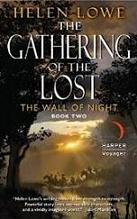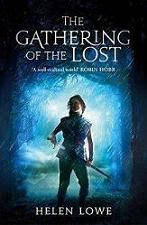

USA
The About The Characters post series focuses on the minor characters in The Wall Of Night series, in large part because:
“I think it’s the presence of the smaller characters that “makes” a story, creating texture around the main points of view.”
~ from my Legend Award Finalist's Interview, 2013
Initially, the series focused exclusively on characters from The Heir of Night, but now I’m continuing on with minor characters from both The Gathering Of The Lost and Daughter of Blood — in alphabetical order, of course!
And—woo-hoo!—we’re now into the letter “L” and The Gathering of the Lost is getting a look-in again. All good. 🙂
—

UK/AU/NZ
Lady Sarifa: a demonhunter and servant of the magi, from the empire of Ishnapur
“…but it was the woman who slipped into the tent in his shadow who caught and held all eyes. She was clad in a full, deep red robe, her hair concealed by a coif of gold mesh worked with garnet and seed pearls. The face within the coif was quartered with crimson and charcoal paint, both eyelids and lips darkened to black. The effect was both rich and a little frightening, and Jehane Mor heard more than one indrawn breath, although no one spoke.
Demonhunter tricks, the herald thought, but did not risk sharing the thought with Tarathan. The Lady Sarifa’s painted lids were half lowered, but Jehane Mor knew that she would be sensing the room.”
~ from © The Gathering Of The Lost, The Wall of Night Book Two: Chapter 8 — The Demonhunter

 Last week, I got to hear two good friends talking over how very much they loved the novel Eleanor Oliphant Is Completely Fine by Gail Honeyman. From which point their conversation shifted to trying to understand why they loved it so much, and why some books generally rock one’s reading world, while another on the same or a similar topic may not work the same magic.
 So “heart”and “soul” probably lie at the heart of what makes stories resonate with readers — but it has to derive from the passion of the writer, and as every author is different, it follows that it’s unlikely there can ever be a formula as to “which” passion, and expressed in “what” way.
 Similarly, it is difficult to say, exactly and precisely, what made a story about an orphan wizard who goes to wizarding school and ends saving the school and eventually the world, resonate quite so powerfully with a generation of readers of all ages, and across many different continents and cultures.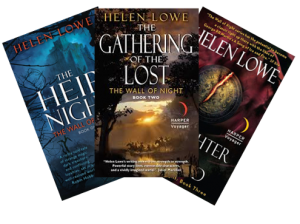


 Yep, it’s November 1 – and the end of the year is rushing my way; yours, too, I bet!
 On reflection, the post title should probably be: “The Boy, the mole, the fox and the Horse” by Charlie Mackesy — with a segue to Twitter… O-o” 😉

 I wasn’t always a reader of detective novels and police procedurals, but was introduced to them by my sister, primarily through Henning Mankell’s Kurt Wallender novels. I’m still not a big reader in the genre, but there are some great characters and stories out there to be discovered. Plus when you’re (“one is” 😉 ) writing in one field, i.e. fantasy (but even more specifically at present, epic fantasy), reading a completely different kind of story can be really enjoyable, as well as relaxing.
 Despite these similarities, if detective fiction is a continuum, then I believe Ann Cleeves’ novels sit closer to those of Kate Atkinson than they do to the works of Henning Mankell, or Lynda La Plante’s Prime Suspect. In the latter two cases, and despite the importance of the character interactions, the crime and the unravelling thereof remain front and centre of the storytelling.
 I realise that I’m not telling you much about the actual plot, instead focusing on what kind of story it is—which is what I believe is most important in this case. Being detective/police procedural fiction, it’s a given that there is a crime (in this case a murder), suspects, and an investigation. In The Darkest Evening, both the scene of the murder and some of those present are directly connected with Vera’s own past, which enables the series to develop alongside the specific story being told. Otherwise, if you like the sound of the character-driven storytelling, I can only encourage you to dive in and read. J