
Despite winter and school holidays here in the southern hemisphere, and the long summer break in more northern regions, July saw a renewed flurry of activity on the blog—which made me think it could be fun to look at the top 10 posts from July.
So without further ado, here’s what you were most interested in last month:
1. Writing Epic Heroines on July 23rd, just pipped
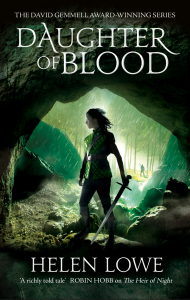
2. Daughter Of Blood, The Wall Of Night Book Three: UK Cover Revealed! on July 13, which was immediately preceded by
3. A Teaspoonful of Anticipation, both earlier in the day and in terms of level of reader interest.
So nice that you awaited the cover reveal with as much anticipation as me. đ
4. Reprising Place As Person — What Does It Mean When Telling Story was also of considerable interest on July 9, as was
5. Well, It’s Done: The (Great) Daughter Of Blood Copyedit’s A Wrap, which featured on July 16
While the 6th most popular post in July came from guest Janis Freegard:
6. Guest Post: Janis Freegard Interviews Three Characters From Her Debut Novel, âThe Year of Fallingâ only last Monday, July 27, before
7. The Kind Of Books I Write: I Expand Friday’s Answer made its bow on 20 July
8. When Characters We Love Die found favour at the very beginning of the month on 2 July, while
9. So What Kind Of Books Do You Write appeared on July 17 , with the final place going to
10. And So It Begins Again on July 24 — a nice start for the very first post everz on The Chaos Gate (The Wall of Night Book Four)
So there you have it, a month told in posts! More “…on Anything, Really” goodness. đ
Fey
your door
stands open still
at dusk, your light
a mothâs antenna
across
shadowed lawn
bare feet rustle
in last yearâs
leaf drift, a wind
sways
through naked trees
you say
you will hang
a cricket cage
above your lintel,
burn apple wood
in the grate â
dance, the circle
of your skirt
reflecting
the moonâs dark face
I ride
a rocking horse
with patchwork eyes,
steal
through your door
to the cold-stone hearth â
dream
of dervish footsteps
hurdy-gurdy trees
(c) Helen Lowe
Highly Commended, Takahe National Poetry Competition 2008
Published in Takahe 68, December 2009
â
I think of this as an autumn poem, but somehow, with our Southern Hemisphere winter turning toward spring again, it suits both my mood and the season.
—
Don’t forget to read the featured poem on the Tuesday Poem Hub and other great poems from fellow Tuesday poets from around the world—just click here.
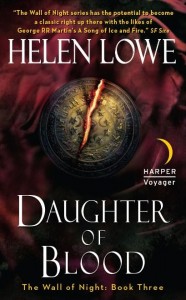
On Saturday I gave the US cover for Daughter Of Blood, The Wall Of Night Book Three it’s first outing.
Yesterday, I shared a bit more of the new cover excitement by featuring the front and back cover quotes.
Today I thought I’d share the back cover “blurb” — which is similar to the UK back-cover text, shared here, but “not quite” the same:
Malian of Night and Kalan, her trusted ally,
are returning to the Wall of Nightâbut already it may
be too late. The Wall is dangerously weakened,
the Nine Houses of the Derai fractured by rivalry
and hate. And now, the Darkswarm is rising . . .
.
Among Grayharbor backstreets, an orphan boy
falls foul of dark forces. On the Wall,
a Daughter of Blood must be married off to the
Earl of Night, a pawn in the web of her familyâs
ambition. On the Field of Blood, Kalan fights for
a place in the brideâs honor guard, while Malian
dodges deadly pursuers in a hunt against time
for the fabled Shield of Heaven. But the Darkswarm
is gaining strength, and time is running outâfor
Malian, for Kalan, and for all of Haarth . . .
Goodness, it really sounds rather exciting, I must say…
Both synopses, of course, are drawn from the one I shared way back in January 2014:
Sneak Preview: A Synopsis For âDaughter Of Blood, The Wall Of Night Book Threeâ
All good fun!
And as well as the overall ‘effect’, including the drama of that line of fire through the shield, it’s also good to see that very nice quote from SF Site getting the front cover limelight.
It’s very difficult, after all, to be anything but enthusiastic about:
“Helen Lowe’s  Wall of Night series has the potential to become a classic right up there with the likes of George RR Martin’s A Song of Ice and Fire.” ~ SF Site
w00t, in fact! đ
The other quotes used for the US cover include:
On the back:
A Gemmell Award-Winning Series
âA richly told tale of strange magic,
dark treachery, and conflicting loyalties,
set in a well-realized world.â
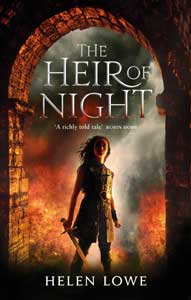
Robin Hobb, on The Heir of Night
And on the inside front:
âThis is an author with
a gift for fantasy.â
Nebula Award-winning author
Catherine Asaro
plus:
â[Lowe] reinvigorates
the epic fantasy
with appealing
characters and a
richly detailed world.â
Library Journal
All very nice — & of course, thank you very much for the vote of confidence!
It was meant to be revealed here in mid-July — but after all, what better way to see in August than with the very first “…on Anything, Really” outing for the US cover for Daughter Of Blood.
So here it is, in all it’s glory: enjoy!
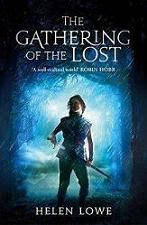
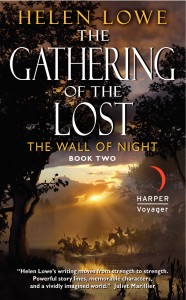
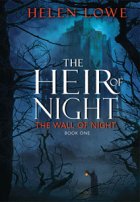
This cover heralds the re-release of The Wall of Night series in the US, so there’ll be matching covers for The Heir of Night & The Gathering of the Lost as well — also coming very soon, I believe.
Clarification Re Availability of the US E-Book:
When the UK cover for Daughter Of Blood The Wall Of Night Book Three was released recently, a commenter, Simon, asked the following question:
“…I tried to pre-order a Kindle edition of the book from Amazon USA, and none was available; only a mass market paperback was available for pre-order. So my question is, is it still the case that a Kindle version will be released in the USA in January?”
I have double checked and the good news, straight from Harper Voyager in the US, is that:
“Yes, weâll release the e-book of Daughter Of Blood simultaneously with the mass market paperback.”
The publisher is also checking to find out why the e-book edition is not showing up currently—but it will be available in January.
As my regular readers will know, on the first of the month (US Eastern Standard Time) I post on the Supernatural Underground—and that will be later today, NZ time.
As you may also know, earlier in the month I heralded the reveal of both the US and UK covers for Daughter Of Blood, The Wall Of Night Book Three — but then only ended posting the UK cover both here and on the Supernatural Underground. (For “reasonsz” — which would never, of course, include copyedit-induced authorial confusion…)
However, better late than never as the adage goes, so later today (NZ time; on the stoke of 1 minute past midnight, US [EST] time) I shall be featuring the US cover for Daughter Of Blood both here and on the Supernatural Underground simultaneously—and talking about the new (US) covers proposed for The Heir Of Night and The Gathering Of The Lost as well.
And I shall also be answering the question asked by Simon Ellberger about Daughter Of Blood ebook availability in the USA.
So you see, it is all happening later today!
After a brief copyedit-induced hiatus, my guest series Fantasy Heroines That Rock My World has resumed on SF Signal.
The sixth heroine on my personal podium is Bitterblue, from Kristin Cashore’s novel of the same name. To find out why, click on:
Helen Lowe On Fantasy Heroines that Rock Her World: Bitterblue (Graceling)
If you’re interested in reading more, I interviewed Kristin Cashore about Bitterblue when the novel first came out, here:
An Interview With Kristin CashoreâAuthor of âBitterblueâ
Last week I discussed Writing Epic Heroines, mainly in the context of the Wall Of Night series.
But Thornspell, as a fairytale retelling, presented a unique challenge in terms of writing heroines.
The fairytale, you see, is Sleeping Beauty, the retelling told from the point of view of the prince who breaks the spell—and I quickly realized that 21st century readers were just not going to âbuyâ the traditional ending.
You know the one: where the prince wakes the princess with the magical kiss, they fall instantly in love and live happily ever after. (And then there is the Grimm version, but Thornspell is Junior fictionâŚ)
At any rate, I realized that I was going to have to both generate other heroines within the story—and also find a way to focus on the princess a lot earlier in the book. Which I did …
The other aspect of writing heroines in Thornspell arose from the fact that it’s a retelling from the point of view of the prince. Naturally, this means he has to be the main character. And since he is a boy growing up in the late-medieval era of this world, a number of the influential characters around him are also men, most notably his master-at-arms, the enigmatic Balisan.
The arch-nemesis of the tale is the wicked fae, who although undoubtedly epic is also a villainess, the Margravine zu Malvolin. So I felt it was important to have some equally strong but positive female characters into the story—an impetus that dovetailed with the need to have a cast of heroines other than the sleeping princess.
One obvious choice was the good fairy whose magic converted the original death spell into the one hundred years’ sleep: Syrica, in this book. She was joined by Auld Hazel, the witch of the wood, and two serving girls: a mute called Rue who becomes one of the prince’s more unexpected allies, and a childhood companion, Annie. And then, of course, there’s the sleeping princess who has to be present, rather than absent, in the story …
As I wrote last week, “listening to the story and being open to possibility are always key to developing characters.” In developing Thornspell, the process of listening involved being open to the needs of the story as it evolved, while being guided by the classic story without rigidly adhering to its form–which allowed both the cast of heroines, but also other characters such as Balisan, to evolve and step forward naturally, taking their place on the page.
~ by Rebecca Fisher
.
Introduction:
After the release of Bryan Singer’s first X Men movie back in 2000 (wow, has it really been that long?) it seemed natural to capitalize on its success by green-lighting an animated series. The last time these particular characters had been given this treatment was back in the 90s â and though that show is remembered fondly, itâs definitely dated badly.
I was curious to see if the same thing had happened to X Men Evolution, as my sister was a huge fan back when it originally aired, and I also remembered enjoying the new incarnations of all my favourite characters. As it happens, there are some aspects that are a little cringe-worthy, but when watched as a whole (yes, I binge-watched all four seasons) it’s still a surprisingly coherent and suspenseful story.
Premise:
What separates X Men Evolution from other takes on the original comic-book material is the de-aging of many characters back into teenagers. As such, the likes of Scott Summers (Cyclops) and Jean Grey are introduced as students attending Bayville High School whilst boarding at Professor Xavier’s Institute for Gifted Youngsters.
Across the course of the first season, more young mutants are discovered and brought to the Institute, including Kurt Wagner (Nightcrawler), Kitty Pryde (Shadowcat) and Evan Daniels (Spyke), learning how to control their abilities while attempting to blend in among their peers.
From left: Shadowcat, Nightcrawler, Jean Grey, Cyclops, Rogue and Spyke
Unbeknownst to Xavier’s students, their school principal Miss Darkholme is really Mystique in disguise, who’s busy rounding up her own team of mutants: the Brotherhood. Standing on the outskirts of both factions is the aptly named Rogue, a Goth teenager with impressive powers who is highly coveted by both sides of the mutant cliques.
Often the show (especially in its early seasons) can feel a bit like a teen drama involving characters who just happen to have superpowers. Unlike the comics or films, the science-fiction element of the story is kept to a relative minimum, with the focus instead on adolescent crushes, fitting in at school, and rivalry among the two mutant groups. One episode for example, involves the X Men and Brotherhood going on a school field trip and getting into a competition about which team can reach the summit of Mount Humiliation first.
Yet as the series goes on, the writers start bringing in more of the traditional X Men storylines …
Story:
From a rather patchy first season, which mainly serves as an introduction to all the main characters, the show starts to delve into more adult themes. As Xavier’s long-term rival, Magneto considers mutants the dominant species on the planet, and plans to recruit individuals to join his isolationist vision for the future. Across the second and third season, the students must deal with the hostility and prejudice they face when theyâre “outed” as mutants, as well as government programmes that perceive them as a threat.
The third season also begins laying the groundwork for Apocalypse, an ancient mutant bent on conquering the planet (and soon to be featured in the upcoming film), whom all the mutants must unite to defeat in the fourth and final season.
Xavier tries to negotiate with Apocalypse
Although there are a few filler episodes â some of which can be incredibly strange â the series as a whole was carefully planned and plotted, with foreshadowing of future events and plot devices planted in early episodes that had payoff much later. The show also makes great use of the mutants’ abilities â Mystique’s shape-shifting, for example, allows her to infiltrate Xavier’s Institute across several episodes without either the characters or the audience realizing who she really is.
Characters:
The retooling of certain characters from their original incarnations resulted in some interesting dynamics among the cast, and have certainly made an impact on how people view the franchise. Before X Men Evolution, Shadowcat and Nightcrawler were not widely recognized characters to those outside comic book readership, and the idea of making Rogue a Southern Goth proved incredibly popular.
All the X Men. No I’m not going to name them all.
Not all their creative decisions were a success. Spyke was an original character, one introduced as Storm’s nephew and designed to embody the rebellious teen persona, but he never really gelled with the rest of the cast and eventually ceased to be a regular in season three. On the other hand, the show also came up with the idea for X23, a young female clone of Wolverine, designed and trained as a weapon, who proved popular enough to get her own comic book spin-off.
Most refreshing of all, the show is not monopolized by Wolverine, who here can best be described as a bodyguard and trainer for the students (and the de-aging of Scott and Jean means there’s no love triangle either).
As ever, it’s always interesting to see what different writers will do with the same set of characters, and X Men Evolution had some innovative ideas in handling the expansive material.
Conclusion:
It was fun revisiting this show, and I was surprised by how well it held up. Some of the animation can be a bit stilted, but other times it’s incredibly impressive, as when Rogue absorbs Mystique’s shape-shifting abilities and morphs into other mutants in quick succession.
It all ended on something of an open note, with clear foreshadowing for a non-existent season five that would have tackled the famous Jean Grey/Phoenix saga, but the show still manages to wrap-up most of its important plot-threads. Since the movie franchise is still going strong nearly fifteen years later, there’s no better excuse to check out another take on the familiar material.
.
Next Time: Sinbad
It only lasted a single season back in 2012 and was apparently trying to jump on the fantasy-series bandwagon popularized by the BBC’s Merlin. So where did Sinbad go wrong?
.
About The Reviewer:
Rebecca Fisher is a graduate of the University of Canterbury with a Masters degree in English Literature, mainly, she claims, because she was able to get away with writing her thesis on C.S. Lewis and Philip Pullman. She is a reviewer for FantasyLiterature.com, a large website that specializes in fantasy and science-fiction novels, as well as posting reviews to Amazon.com and her Theyâre All Fictional blog.
To read Rebeccaâs detailed introduction of both herself and the series, as well as preceding reviews, click on:
Big Worlds On Small Screens
Rebecca has recently won the Sir Julius Vogel Award 2015 for Best Fan Writer, for writing including Big Worlds On Small Screens.