
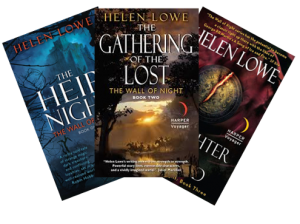
 … or at least, proving singularly uncooperative.
I have vague recollections – without being able to point to specific examples, mea culpa – of other authors lamenting this phenomenon, which leads me to believe I am by no means the first to experience it.
It’s no secret either, that once begun, stories and characters tend to develop a life of their own – chiefly, imho, because both the narrative and the characters evolve as the story progresses. The characters respond to events, which leads them to change and grow, including in their subsequent actions and responses, hence the narrative also changing. Very like real people, in fact, and since they are real in the world of the story, it’s probably just as well that they do alter and evolve, even if it’s not always convenient for the author.
Or as Field Marshall von Moltke (I believe) said, “No plan survives contact with the enemy.” No, indeed.
Almost 100% of the time, though, the alteration proves beneficial to the story, even when a departure from the original plan. Almost as if the characters know a thing or two about themselves. Unfortunately that self-knowledge often evolves deep in the authorial subconscious and can take a frustratingly long time to work its way to the conscious “working face”: O-o!
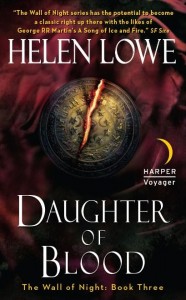
USA
The most recent instance was of a slightly different order and involved the character of Thanir, a Darksworn antagonist that The Wall of Night readers will have encountered in Daughter of Blood. (Yes, he is in The Chaos Gate, but as he survived the events at the end of Daughter, I don’t think that’s a spoiler. 🙂 )
I have a pretty good understanding of Thanir’s backstory and – as I thought – his motivations, but those of you who recall his character will know that he is enigmatic at best. So on coming to the crunch of last month’s sequence, I discovered that his character was even more complex than I realized and his motivations equally challenging to unravel.
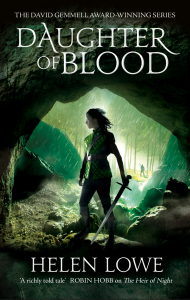
UK/AU/NZ
All of which lay at the core of my calling last month’s endgame sequence “a little tricky” – and what was in my mind, also recently, when I quoted Haruki Murakami’s: “My stories are always unpredictable to myself.”
Although when it comes to Thanir, I may also need to paraphrase Lady Caroline Lamb on the subject of Lord Byron. She declared that the famous (and infamous) poet was “mad, bad, and dangerous to know.”
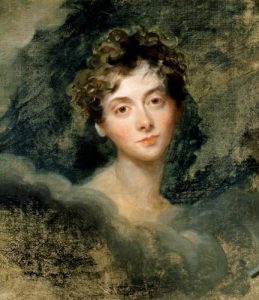
Lady Caroline Lamb, painted by Sir Thomas Lawrence
The paraphrase, in this case, is that Thanir is “difficult to know”, although the Derai would probably fully concur with the “bad, and dangerous” part, too. 😀
It’s the author’s job, of course, to unravel the motivations of even the most enigmatic and difficult-to-know characters – and so unravelled they were, at least sufficiently to advance the story.
All part and parcel of the writing life, albeit requiring considerably more than a day’s work. 😉
—
Previous Bulletins From Inside The Writing Life:
- A Little About The Writing Itself
- About Those Muses, Then…
- Naturally Self-Isolating
- Writing Novels, Posting Blogs
- Another Milestone Ticked Off
- A Game Of Two Halves
- Further Reflection on Writing Transitions
- Fun With Friends
- Those Moments Of “Grr-Argh”
- Sometimes It’s A Case Of “Oh Frabjous Day!
- “O Frabjous Day” Reprised
- Listening To The Silence

 Last
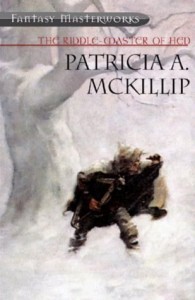
Last  It’s amazingly evocative and atmospheric writing. It’s also setting up the next action sequence at one level, while simultaneously “lulling” the reader at another. Do I appreciate the author’s craft? Yes, I do. 😉
 And as I’ve mentioned in other posts, when it comes to the second book in particular (Heir of Sea and Fire), and the character of Raederle of An, the Riddlemaster storyline doesn’t stay in that traditional space. In fact it was one of the first epic fantasies I encountered that not only introduced empowered and engaging female characters, but also included a major female point-of-view character in the series.


 I believe this to be fact, if not necessarily universally acknowledged… When I read the quote for the first time I stood right up and cheered. 😀
 As a reader and writer, I love the way the poems and books I heart always stay with me.
 The leaves and the sea are doubtless reason enough for shouting those words into the wind, but given the grandeur and wildness of the unexpected squall, I did wonder if it might not be a moment for lines that appear later, in The Return of the King:
 If you would like to reflect further on ANZAC Day itself, the following link to ANZAC reflections, including poetry, that I’ve posted in other years:


 In my recent
  The interview is wide-ranging, but the parts that really resonated for me were when Murakami spoke about the writing process. Here are a few examples:
 And this:
 Mine definitely work in their own mysterious ways, their wonders to perform. And are not infrequently shapeshifters to boot – just when you think you’ve got them tied down, there they go, shifting again: not unlike Menelaus and the Old Man of the Sea…